
Overview
"I want to build the world's best school on these hills of Tamagawa"
It was in 1929 that Kuniyoshi Obara, the founder of Tamagawa, opened his ideal school. In 1947, Tamagawa University was established with the Faculty of Arts and Education and Faculty of Agriculture, based on the belief that "Agriculture is the foundation of a nation." Since then, the University has made steady progress along with the times, establishing a correspondence school for lifelong learning and the Faculty of Engineering in 1962. The number of subjects available grew with changing social needs and the acceleration of growth, and the University has changed to respond to social development.
The reorganization of schools and departments started in 2000 with the aim of establishing an educational and research institute geared for the 21st century. In 2000, the School of Business Administration was established to foster business leaders able to assume important roles in international society. In 2001, the Departments of Education and the Faculty of Arts were made the independent Colleges of Education and Arts, and the Departments of Human Sciences and International Studies were established in the School of Humanities. In 2002, the Department of Liberal Arts was founded in the School of Humanities, and the Department of Early Childhood Care Development and Education became a part of the College of Education. A departmental reorganization took place for the Faculty of Engineering in 2004 and the Faculty of Agriculture made a fresh start with three departments in 2005. In 2006, the Department of Comparative Cultures was founded in the College of Humanities, and the Department of Media Arts was founded in the College of Arts. In 2007, the College of Arts and Sciences and the Department of Tourism and Hospitality Management in the College of Business Administration were founded.In 2008, the Department of Software Science was founded in the College of Enginnering. In 2013, the College of Tourism and Hospitality Manegement was founded. In 2014, the Department of Media Arts and Design and the Department of Arts Education were founded in the College of Arts. And in 2015, the Department of English Language Education was founded in the College of Humanities and the Department of Management Science was founded in the College of the Engineering.
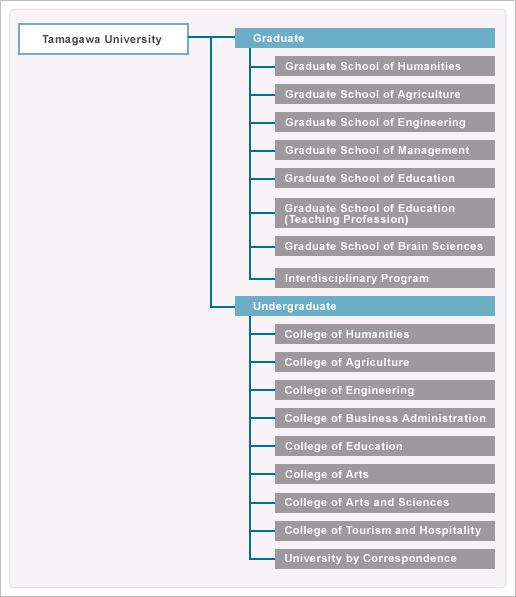
Today, the university consists of 17 departments in 8 faculties (undergraduate), as well as eight programs leading to a master’s degree, leading to a professional degree (Teaching Profession Major) and three programs leading to a doctoral degree.
Tamagawa University Graduate School was established to achieve the apex in the teaching and research of academic theories and their applications, in the hope of contributing to the overall development of academic culture and welfare for humanity. At the base of these endeavors are the founding spirit of "Zenjin Education" and the related elements, truth, goodness, beauty, holiness, soundness and wealth, which are taught in the undergraduate courses. The Graduate School of Education was established in 2006, and the Graduate School now offers eight master's programs, a professional degree (Teaching Profession Major) and three final term doctoral programs.
Master's programs delve deeply into each area of study from broad perspectives, based on liberal arts studies and specialist studies completed at undergraduate schools. Each of the programs aims to cultivate profound academic knowledge and flexible research capabilities. Meanwhile, the doctoral programs aim at unique and pioneering studies in each academic area, to add new findings to the present academic accomplishments. In fact, some of the research undertaken at our graduate school is at levels that indicate an ability to lead Japan and the world.
Education offered to graduate school students aims at cultivating interdisciplinary and international perspectives, founded on the basics of each area of study.
In the 21st century, Tamagawa continues to develop, in search of new approaches to university education.
Tamagawa University is also using e-Education, employing computer networks to realize a high-quality learning environment. With these initiatives, Tamagawa University has assumed a leading role among universities in Japan.