
全人教育に基づく教師のトリオ(3人組)に関するアクションリサーチ報告書:教師の全人的な育成を目指して
ブライアン・クック著
1. プロジェクトの根拠と背景
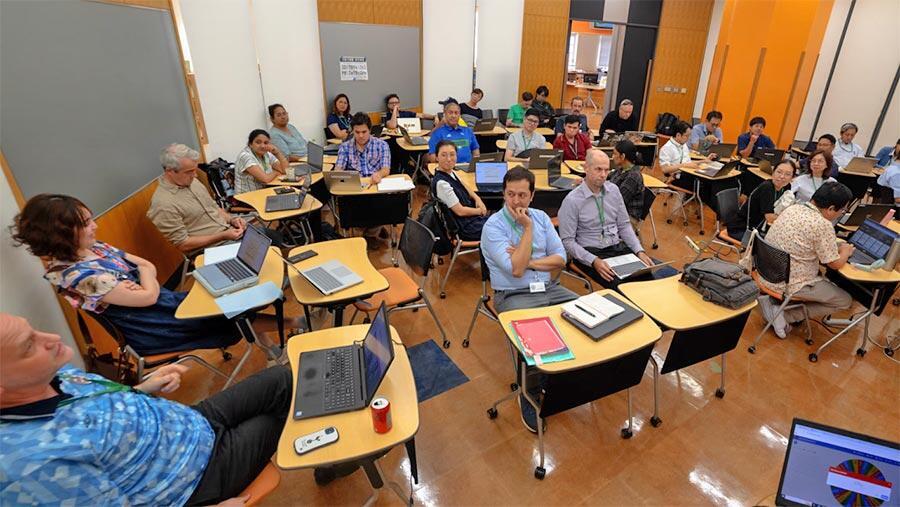
「教師のトリオ(Teacher Trios)」プロジェクトは、玉川学園IBクラス(IB Division)内の教職員に向けた全人(Zenjin)教育的発展を促進するために設立されました。本アクションリサーチは、単なる標準的な教員研修モデルではなく、教師たちが自らの技術を磨くために意図的かつ協力的な労働に従事する**「労作(Rosaku)」**へのコミットメントを具現化したものです。本プロジェクトは、私たちの教育的伝統に根ざした根本的な問いに答えることを目的としています。
「MYP(中等教育プログラム)とDP(ディプロマ・プログラム)の継続的な教育課程において、いかにして指導実践と教科横断的な連携を調和させ、『全人(Whole-Child)』を育成することができるか?」
本プロジェクトの根拠は、教室における**「真(Shin)」と「善(Zen)」**の全人的追求に基づいています。IBの「指導の枠組み(ATT: Approaches to Teaching)」の統合を深めることで、指導の質が一貫しているだけでなく、変革的なものになることを目指します。この介入策はIBセルフスタディ(自己評価)から生まれたものであり、哲学的な理想と教室の現実との隔たりを埋め、すべての授業が学生の知的・道徳的・身体的なバランスの取れた発達に寄与するようにすることを目指しています。私たちは、以下の領域に改善の可能性があることに着目しました。
- 一貫性:教科グループ間でIB ATTの実施にばらつきがあり、それが生徒の体系的な知的発達を妨げる可能性があることを特定しました。これらのアプローチを標準化することで、どの教室においても「全人教育」の経験を保証します。
- 連携:教科を越えた教育法的な交流の機会が限られていること。
- 言語サポート:カリキュラム全体を通じて、生徒の言語発達に対する専門的なサポートのレベルに差があること。
協力的で内省的な指導文化を構築することにより、「教師のトリオ」の枠組みは、本校の改善の優先事項をIBの卓越した指導基準に合致させています。
2. アクションリサーチの探究(The Action Research Inquiry)
3. 調査手法:IB探究サイクル(Methodology: The IB Inquiry Cycle)
一般的な専門的省察を超え、より厳密でエビデンスに基づいた探究へと進展させるため、本プロジェクトは「念(Diligence)」と「労作(Creation/Rosaku)」という全人精神に根ざした構造的な研究枠組みを活用しました。プロジェクトの初期段階では広範な教育的好奇心に焦点を当てていましたが、第2ラウンドの「研究課題の精緻化(Sharpening Research Questions)」フェーズでは、定性的な「気づき(wondering)」から、アイデアの経験的な「検証(testing)」への移行が求められました。
全人教育において、「真(Shin)」は単に見出されるものではなく、行動を通じて証明されるものです。したがって、各「教師のトリオ」は、教師の働きかけと生徒の成長を結びつける具体的な研究課題を策定しなければなりませんでした。これには、特定の指導戦略を意図的に用いることが、いかに観察可能な形で「生徒の行動と成果」に影響を及ぼすかを特定する必要がありました。
私たちの指導アプローチ(ATT)をこの経験的な「検証」フェーズに据えることで、指導の改善が単なる抽象的な理想に終わらず、生徒の「全人的発達(Whole-Child)」を促す生きた現実となるようにしました。
本探究は、以下のIB指導の枠組み(ATT)の6つの柱に位置づけられています:
- 探究型学習(Inquiry-based learning)
- 概念理解(Conceptual understanding)
- 分化(Differentiation)
- ローカルおよびグローバルな文脈(Local and global contexts)
- 評価の活用(Informed by assessment)
- チームワークとコラボレーション(Teamwork and collaboration)
プロジェクトのタイムラインと主な活動
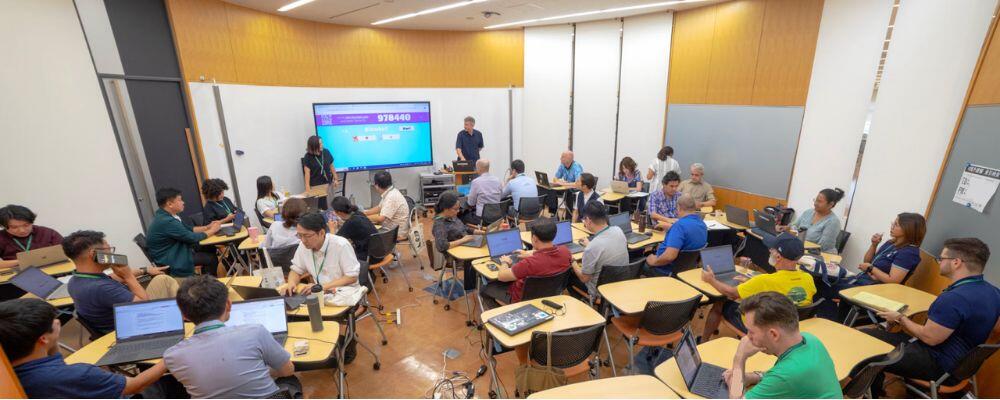
本手法は、IB学習サイクル(探究・行動・振り返り)に基づいています。このプロセスにより、教師はアクションリサーチに従事しながら、カリキュラム計画、指導デザイン、生徒のエンゲージメントに関する実践的な戦略を得ることができます。本サイクルの主な節目は以下の通りです:
- 第1ラウンドの省察(9月): 教師間で授業の相互観察を振り返り、第2ラウンドに向けてより構造化された観察目標を作成。
- 第2ラウンドの省察(1月): 研究課題に対する答えが得られたかを確認し、調査結果をブログ記事として記録する手法を導入。
ステークホルダーの責任
- 教師: 共同目標の設定、相互観察の実施、構造化されたフィードバックの提供、および公式な省察の完了を担当。
- リーダーシップ(運営側): プログラム全体の調整、連携に不可欠なリソースとしての「時間」の確保、およびドキュメントの確認を担当。
- 生徒: 特定の戦略に応じたエージェンシー(主体性)、エンゲージメント、スキル習得の変化を示すことで、主要なエビデンスの源となる。
4. 経験的データ収集プロトコル (Empirical Data Collection Protocols)
年度の後半において、本プロジェクトは「焦点化されたデータ収集プロトコル(Focused Data Collection Protocol)」を導入しました。これは、観察者が「評価者」ではなく「中立的な研究者」として行動することを確実にするためのものです。
教師のパフォーマンスを評価するのではなく、研究課題に答えるために、3〜5つの具体的かつ経験的なデータポイントを収集することに重点を置いています。
経験的データ収集メソッド (Empirical Data Collection Methods)
この表は、観察者が「評価者」ではなく「研究者」として、客観的なエビデンスを収集するための具体的な手法をまとめたものです。
| メソッド (Method) | 焦点 (Focus) | IBとの関連性 (IB Relevance) | データポイントの例 (Data Point Example) | 具体的な用途・指示 (Specific Use/Instruction) |
|---|---|---|---|---|
| 頻度カウント / タリーマーク |
特定の行動や動作の定量化。 | チームワークと生徒のエージェンシー(主体性)。 | 生徒が自発的に発した探究的な質問。 | グリッド(数取表)を用い、生徒が純粋な問いを発するたびに記録し、エージェンシーを測定する。 |
| タイムサンプリング / 時間記録 |
指導時間の配分の測定。 | 分化(個別化)と探究。 | 個別のフィードバックに費やした時間。 | ストップウォッチを使用し、特定のグループに費やした時間を記録して、アクセスの公平性を評価する。 |
| 逐語録 / 発言の書き出し |
教室内の正確な言語の記録。 | 概念理解。 | 概念と文脈を結びつける教師の言葉。 | 正確な語彙を記録し、多言語学習者にとっての「つながり」の複雑さを分析する。 |
| インタラクション・ フローチャート |
コミュニケーションパターンの図式化。 | チームワークとコラボレーション。 | 生徒同士の応答パターン。 | 記号(T=教師 / S=生徒)と矢印を用い、対話が教師主導か生徒主導かをマッピングする。 |
| 移動・ 近接マッピング |
教師の物理的な位置の追跡。 | 分化とサポート。 | 高難易度のタスク実施中の生徒への近接度。 |
ベストプラクティスの原則: すべてのデータは**中立(ニュートラル)**であり、非評価的でなければなりません。観察者の役割は、生の証拠(例:「教師はグループ1に6分間を費やした」など)を収集することに限定されます。その後、トリオ(3人組)がデブリーフィング(報告会)において、その証拠を共同で解釈します。
5. 共同フィードバックと分析プロトコル
本プロジェクトでは、同僚間のフィードバックを分析的なものにし、専門性の向上につなげるために、構造化されたプロトコルを活用しました。
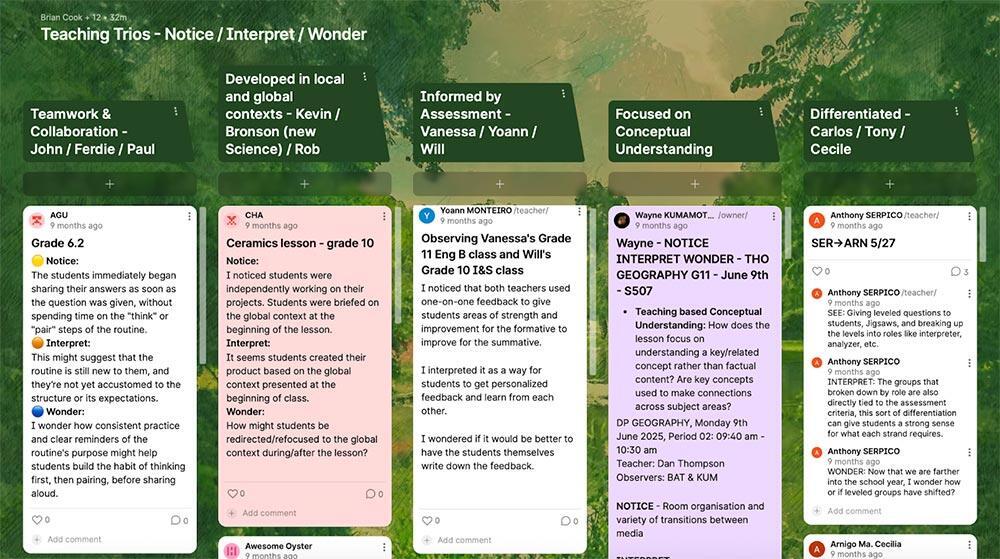
「Notice / Interpret / Wonder(気づき・解釈・問い)」プロトコル
このプロトコルは、Padlet(オンライン掲示板)を通じて共有されるフィードバックを整理するために使用されます。
- Notice(気づき): 観察可能な事実の客観的な報告。
(例:「生徒たちがディスカッションを主導していることに気づきました」) - Interpret(解釈): エビデンスに基づいた含意の導出。
(例:「生徒たちはプロトコルを使用することに自信を持っているように見受けられました」) - Wonder(問い): 将来の探究を促すための質問の提示。
(例:「生徒たちがこのような自律性を発揮できるよう、どのような準備を支援したのか気になりました」)
テーマ別分析と共有 (Thematic Analysis and Sharing)
- 「フォー・コーナーズ」セッション: 教師たちは、**「生徒のエージェンシー(主体性)」「実社会との関連性」「フィードバック/フィードフォワード」「構造化された柔軟性」**という4つの柱に沿って、成功事例と課題のテーマ別分析を行います。
- トリオ間ギャラリーウォーク: 異なるトリオ間で成功事例や課題を共有し、学校全体の共通テーマや、効果的な教育的手段(レバー)を特定します。
- テクニカルツールとしての「観察ログ」: 観察ログは、タイムスタンプ、逐語的なエビデンス、および集計(タリー)を記録するために使用されます。このログは、デブリーフィング(振り返り)における**「三角測量(トライアンギュレーション)」**のための不可欠なツールとなり、観察者のデータと教師自身の経験を照らし合わせることで、研究課題(Research Question)への回答を導き出します。
6. リフレクションと専門性向上の枠組み (Reflection and Professional Growth Framework)
個人の成長や概念的な変化を測定するために、特定のルーチンを通じてリフレクションを標準化しています。
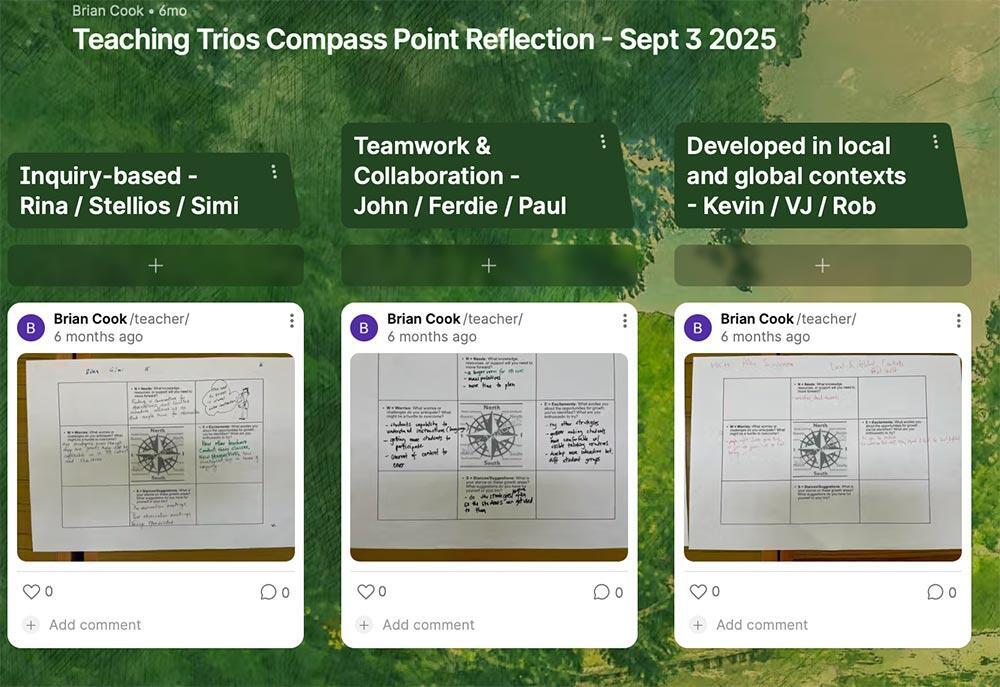
「コンパス・ポイント(羅針盤)」ルーチン
教師はこのルーチンを個人の目標設定やトリオ内での共有に適用し、以下の具体的な問いに答えます。
- Excitements / 高揚(East - 東): 特定した成長の機会について、何にワクワクしていますか? 何を試してみたいと熱望していますか?
- Worries / 懸念(West - 西): どのような不安や課題が予想されますか? 克服すべき障害は何でしょうか?
- Needs / 必要(North - 北): 前進するために必要な知識、リソース、またはサポートは何ですか? Stances/Suggestions /
- 立場・提案(South - 南): これらの成長領域に対してどのような立場(考え)をとりますか? 自分自身やトリオに対してどのような提案がありますか?
概念の転換 (The Conceptual Shift)
第2ラウンドのワークブックでは、**「以前は~と考えていたが、今は~と考える(I used to wonder... Now I think...)」というルーチンを使用しています。これは、4月時点の広範で初期的な「問い」から、第2ラウンドの観察で適用された「具体的な戦略」へと至るまでの、「概念的な飛躍(コンセプチュアル・リープ)」**を記録するためのものです。
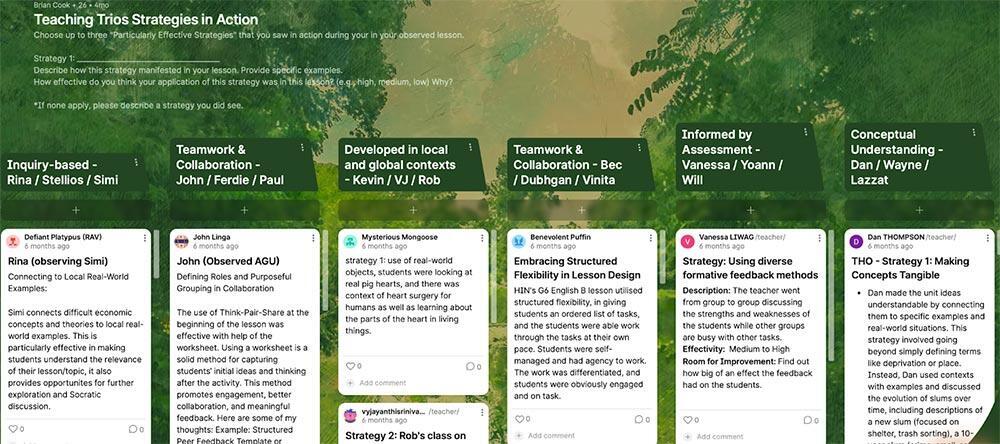
特に効果的な戦略 (Particularly Effective Strategies)
各トリオの活動を通じて、以下の**「影響力の高い教育的レバー(手段)」**が共通して特定されました。
- 質問スキルの明示的な指導: 生徒が自ら問いを立てる方法を具体的に教えること。
- 共同学習における役割定義と目的のあるグループ分け: 協力体制を強化するための構造化。
- 地域の身近な実社会事例との関連付け: 学習内容を現実世界に結びつけること。
- 多様な形成的フィードバック手法の活用: 多角的な評価と助言の提供。
- 選択制とピア・ラーニング(仲間との学び)による分化: 生徒の特性に応じた個別化。
- 概念の明示化とその応用: 抽象的な概念を具体的に使いこなせるようにすること。
- 学習における生徒のエージェンシーと能動的参加の促進: 主体的な学びの強化。
- 授業デザインにおける「構造化された柔軟性」の受容: 計画性を持ちつつ、状況に応じた柔軟な対応。
7. 結論と今後の展望 (Conclusion and Future Considerations)
「教師のトリオ」プロジェクトは、生徒の学習成果を長期的に改善するための強固な枠組みを提供します。
生徒への期待される影響:
- 指導アプローチ(ATT)スキルの適用における一貫性の向上: 教科を横断した統一感のある指導。
- 探究ベースおよび概念主導の指導によるエンゲージメントの強化: 学習への意欲と関心の向上。
- コミュニケーションと部門間連携の強化。
本プロジェクトの締めくくりとして、これらの成功した戦略が実際に機能している様子を捉えた「写真によるエビデンス」を含む、最終的なブログ記事を作成します。これらのエビデンスに基づく知見は、**「玉川学園指導標準(Tamagawa Teaching Standards)」に照らして評価されるとともに、「IBの学習者像(IB Learner Profile)」**の育成とも合致しており、本校の教育文化に対して持続的なインパクトを与えることを確実なものにします。
引用文献 (Citation)
クック、ブライアン「アクションリサーチプロジェクト報告書:教師のトリオ・フレームワークを通じた指導実践の強化」玉川学園 K-16研究センター、2026年4月1日、[URL]。本報告書の作成にあたっては、Gemini(Google)の支援を受けた(2026年3月17日)、https://gemini.google.com/
Cultivating the Whole Educator: A Zenjin-Based Action Research Report on Teacher Trios
by Brian Cook
1. Project Rationale and Context
The Teacher Trios project was established to develop Zenjin (Whole-Person) development for the faculty within Tamagawa’s IB Division. Rather than a standard model of professional development, this action research initiative represents a commitment to Rosaku as teachers engage in the intentional, collaborative labor of refining their craft. It seeks to answer a fundamental question rooted in our educational heritage:
"How can we harmonize our teaching practices and interdisciplinary collaboration to cultivate the 'Whole-Child' across the MYP and DP continuum?"
The rationale for this project is grounded in the Zenjin pursuit of Truth (Shin) and Goodness (Zen) within the classroom. By deepening the integration of IB Approaches to Teaching (ATTs), we aim to ensure that the quality of instruction is not only consistent but transformative. This intervention was born from our IB self-study, identifying a need to bridge the gap between philosophical ideals and classroom reality, ensuring that every lesson contributes to the balanced development of our students' intellectual, moral, and physical selves. We noticed these areas as holding potential for improvement:
- Consistency:We identified a lack of uniform implementation of IB ATTs across subject groups, which can disrupt the cohesive intellectual development of the student. By standardizing these approaches, we ensure a "Whole-Education" experience regardless of the classroom.
- Collaboration:Varied levels of specialized support for student language development across the curriculum.
- Language Support:Varied levels of specialized support for student language development across the curriculum.
By building a collaborative, reflective teaching culture, the Teacher Trios framework aligns our school improvement priorities with the IB’s standards for teaching excellence.
2. The Action Research Inquiry
To move beyond general professional reflection toward a more rigorous, evidence-based inquiry, the project utilized a structured research framework rooted in the Zenjin spirit of Diligence and Creation (Rosaku). While the initial phase of the project focused on broad pedagogical curiosity, the "Sharpening Research Questions" phase in Round 2 demanded a transition from qualitative "wondering" to the empirical "testing" of ideas.
In Zenjin Education, Truth (Shin) is not merely found; it is proven through action. Therefore, each Teacher Trio had to formulate a specific research question that connected teacher labor to student growth. This required identifying how the intentional use of a specific teaching strategy would impact Student Action and Outcomes in an observable way.
By grounding our Approaches to Teaching (ATT) in this empirical "testing" phase, we made sure that our teaching improvements would not just be abstract ideals, but lived realities that would develop the "Whole-Child."
This inquiry is situated within the six core IB Approaches to Teaching (ATT):
- Inquiry-based learning
- Conceptual understanding
- Differentiation
- Local and global contexts
- Informed by assessment
- Teamwork and collaboration
3. Methodology: The IB Inquiry Cycle
The methodology is founded upon the IB Learning Cycle (Inquire, Act, Reflect). This action-research process allows teachers to engage in action research while gaining practical strategies for curriculum planning, instructional design, and student engagement.
Project Timeline and Major Activities: The framework consisted of two structured observation rounds over the school year. Key milestones in the current cycle included:
- Round 1 Reflection: In September, teachers reflected on the peer observations of lessons, and created more structured observation aims for Round 2.
- Round 2 Reflection: In January, teachers determined if their research questions had been answered, and were introduced to the idea of documenting their findings in a blog post.
Stakeholder Responsibilities:
- Teachers: Responsible for collaborative goal setting, conducting peer observations, providing structured feedback, and completing formal reflections.
- Leadership: Responsible for the overall coordination of the programme, the provision of time as a vital resource for collaboration, and the review of documentation.
- Students: Serve as the primary source of evidence by demonstrating shifts in agency, engagement, and skill acquisition in response to specific strategies.
4. Empirical Data Collection Protocols
Over the second half of the school year, the project introduced a "Focused Data Collection Protocol" to ensure that observers act as neutral researchers rather than evaluators. The focus is on gathering 3 to 5 specific, empirical data points to answer the research question without passing judgment on the teacher's performance.
Empirical Data Collection Methods
| Method | Focus | IB Relevance | Data Point Example | Specific Use/Instruction |
|---|---|---|---|---|
| Frequency Counts / Tally Marks |
Quantifying specific behaviors or actions. | Teamwork & Student Agency. | Student-initiated inquiry questions. | Use a grid to tally every time a student asks a genuine question to measure agency. |
| Time Sampling / Duration Recording |
Measuring the allocation of instructional time. | Differentiation & Inquiry. | Time spent giving individual feedback. | Use a stopwatch to record minutes spent with specific groups to address equity of access. |
| Verbatim Scripting / Quote Capture |
Recording exact language used in the room. | Conceptual Understanding. | Teacher language connecting concepts to context. | Record exact wording to analyze the complexity of connections for multilingual learners. |
| Interaction Flow Charting |
Mapping patterns of communication. | Teamwork & Collaboration. | Peer-to-peer response patterns. | Use symbols (T/S) and arrows to map if dialogue is teacher-led or student-driven. |
| Movement/ Proximity Mapping |
Tracking teacher's physical location. | Differentiation & Support. | Proximity to students during high-challenge tasks. | Map the classroom into zones and record time spent in each to assess targeted support. |
Best Practice Principle: All data must remain neutral and non-evaluative. The observer's role is to collect raw evidence (e.g., "The teacher spent 6 minutes with Group 1") which the trio then interprets collaboratively during the debrief.
5. Collaborative Feedback and Analysis Protocols
The project utilized structured protocols to ensure that peer-to-peer feedback was analytical and led to professional growth.
Notice / Interpret / Wonder Protocol This protocol is used to structure feedback shared via Padlet:
- Notice: Objective reporting of observable facts (e.g., "I noticed students leading the discussion").
- Interpret: Drawing evidence-based implications (e.g., "It seems they were confident using the protocol").
- Wonder: Posing questions to spark future inquiry (e.g., "I wonder how you helped students prepare for this autonomy").
Thematic Analysis and Sharing
- Four Corners Session: Teachers engage in thematic analysis of successes and challenges across four pillars: Student Agency, Real-World Relevance, Feedback/Feedforward, and Structured Flexibility.
- Inter-Trio Gallery Walk: Successes and challenges are shared across different trios to identify school-wide themes and common pedagogical levers.
- Observation Log as a Technical Tool: The Observation Log is used to record time-stamped, verbatim evidence and tallies. This log serves as a vital tool for triangulation during the debrief, allowing the trio to compare the observer's data with the teacher's experience to answer the Research Question.
6. Reflection and Professional Growth Framework
Reflection is standardized through specific routines designed to measure individual growth and conceptual shifts.
The Compass Points Routine Teachers apply this routine to individual goal-setting and trio sharing using these specific questions:
- Excitements (East): What excites you about the opportunities for growth you've identified? What are you enthusiastic to try?
- Worries (West): What worries or challenges do you anticipate? What might be a hurdle to overcome?
- Needs (North): What knowledge, resources, or support will you need to move forward?
- Stances/Suggestions (South): What is your stance on these growth areas? What suggestions do you have for yourself or your trio?
The Conceptual Shift The "I used to wonder... Now I think..." routine is used in the Round 2 Workbook to document the "conceptual leap" from general initial wonderings in April to the specific strategies applied in the second round of observations.
Particularly Effective Strategies The following high-leverage levers have been identified across trios:
- Explicitly Teaching Questioning Skills
- Defining Roles and Purposeful Grouping in Collaboration
- Connecting to Local Real-World Examples
- Using Diverse Formative Feedback Methods
- Differentiating by Choice and Peer Learning
- Making Concepts Explicit and Applied
- Promoting Student Agency and Active Participation in Learning
- Embracing Structured Flexibility in Lesson Design
7. Conclusion and Future Considerations
The Teacher Trios project provides a robust framework for long-term improvement in student outcomes.
Anticipated Impact for Students:
- Increased consistency in the application of ATTs skills across subjects.
- Enhanced engagement through inquiry-based and concept-driven instruction.
- Stronger communication and cross-department collaboration
The project concludes with a final blog post requiring photographic evidence of these successful strategies in action. These evidence-based insights are measured against the Tamagawa Teaching Standards and are aligned with the development of the IB Learner Profile, ensuring a sustainable impact on the school's pedagogical culture.
Citation
Cook, Brian. "Action Research Project Report: Strengthening Teaching Practices through the Teacher Trios Framework." Tamagawa K-16 Research Centre, 1/4/2026, [URL]. Assisted by Gemini, Google, [17/3/2026], https://gemini.google.com/.
シェアする


関連リンク
