

Cultivating the Whole Educator: A Zenjin-Based Action Research Report on Teacher Trios
by Brian Cook
1. Project Rationale and Context
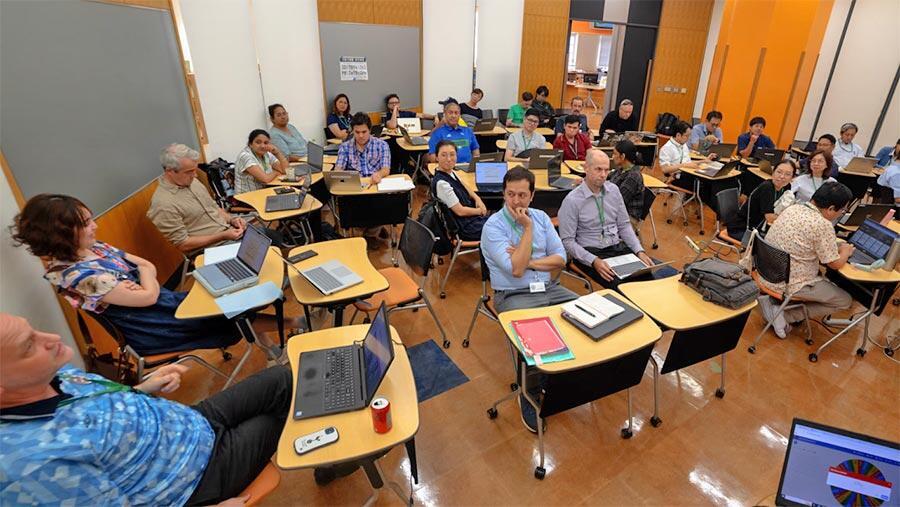
The Teacher Trios project was established to develop Zenjin (Whole-Person) development for the faculty within Tamagawa’s IB Division. Rather than a standard model of professional development, this action research initiative represents a commitment to Rosaku as teachers engage in the intentional, collaborative labor of refining their craft. It seeks to answer a fundamental question rooted in our educational heritage:
"How can we harmonize our teaching practices and interdisciplinary collaboration to cultivate the 'Whole-Child' across the MYP and DP continuum?"
The rationale for this project is grounded in the Zenjin pursuit of Truth (Shin) and Goodness (Zen) within the classroom. By deepening the integration of IB Approaches to Teaching (ATTs), we aim to ensure that the quality of instruction is not only consistent but transformative. This intervention was born from our IB self-study, identifying a need to bridge the gap between philosophical ideals and classroom reality, ensuring that every lesson contributes to the balanced development of our students' intellectual, moral, and physical selves. We noticed these areas as holding potential for improvement:
- Consistency:We identified a lack of uniform implementation of IB ATTs across subject groups, which can disrupt the cohesive intellectual development of the student. By standardizing these approaches, we ensure a "Whole-Education" experience regardless of the classroom.
- Collaboration:Varied levels of specialized support for student language development across the curriculum.
- Language Support:Varied levels of specialized support for student language development across the curriculum.
By building a collaborative, reflective teaching culture, the Teacher Trios framework aligns our school improvement priorities with the IB’s standards for teaching excellence.
2. The Action Research Inquiry
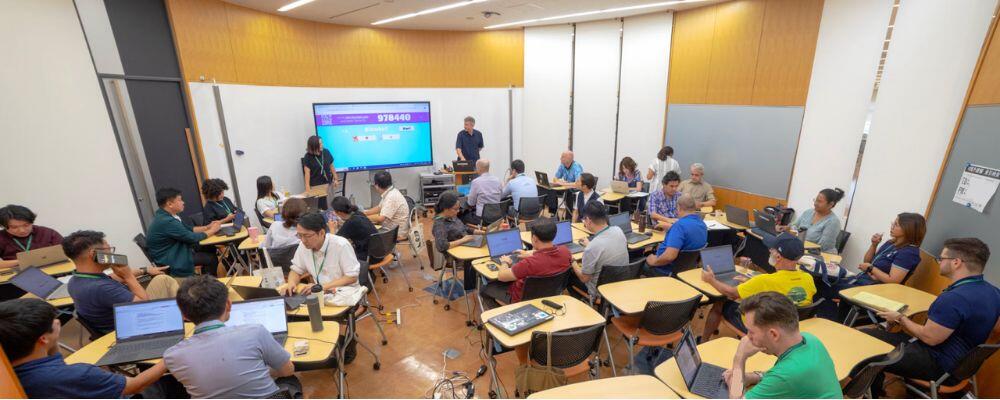
To move beyond general professional reflection toward a more rigorous, evidence-based inquiry, the project utilized a structured research framework rooted in the Zenjin spirit of Diligence and Creation (Rosaku). While the initial phase of the project focused on broad pedagogical curiosity, the "Sharpening Research Questions" phase in Round 2 demanded a transition from qualitative "wondering" to the empirical "testing" of ideas.
In Zenjin Education, Truth (Shin) is not merely found; it is proven through action. Therefore, each Teacher Trio had to formulate a specific research question that connected teacher labor to student growth. This required identifying how the intentional use of a specific teaching strategy would impact Student Action and Outcomes in an observable way.
By grounding our Approaches to Teaching (ATT) in this empirical "testing" phase, we made sure that our teaching improvements would not just be abstract ideals, but lived realities that would develop the "Whole-Child."
This inquiry is situated within the six core IB Approaches to Teaching (ATT):
- Inquiry-based learning
- Conceptual understanding
- Differentiation
- Local and global contexts
- Informed by assessment
- Teamwork and collaboration
3. Methodology: The IB Inquiry Cycle
The methodology is founded upon the IB Learning Cycle (Inquire, Act, Reflect). This action-research process allows teachers to engage in action research while gaining practical strategies for curriculum planning, instructional design, and student engagement.
Project Timeline and Major Activities: The framework consisted of two structured observation rounds over the school year. Key milestones in the current cycle included:
- Round 1 Reflection: In September, teachers reflected on the peer observations of lessons, and created more structured observation aims for Round 2.
- Round 2 Reflection: In January, teachers determined if their research questions had been answered, and were introduced to the idea of documenting their findings in a blog post.
Stakeholder Responsibilities:
- Teachers: Responsible for collaborative goal setting, conducting peer observations, providing structured feedback, and completing formal reflections.
- Leadership: Responsible for the overall coordination of the programme, the provision of time as a vital resource for collaboration, and the review of documentation.
- Students: Serve as the primary source of evidence by demonstrating shifts in agency, engagement, and skill acquisition in response to specific strategies.
4. Empirical Data Collection Protocols
Over the second half of the school year, the project introduced a "Focused Data Collection Protocol" to ensure that observers act as neutral researchers rather than evaluators. The focus is on gathering 3 to 5 specific, empirical data points to answer the research question without passing judgment on the teacher's performance.
Empirical Data Collection Methods
| Method | Focus | IB Relevance | Data Point Example | Specific Use/Instruction |
|---|---|---|---|---|
| Frequency Counts / Tally Marks |
Quantifying specific behaviors or actions. | Teamwork & Student Agency. | Student-initiated inquiry questions. | Use a grid to tally every time a student asks a genuine question to measure agency. |
| Time Sampling / Duration Recording |
Measuring the allocation of instructional time. | Differentiation & Inquiry. | Time spent giving individual feedback. | Use a stopwatch to record minutes spent with specific groups to address equity of access. |
| Verbatim Scripting / Quote Capture |
Recording exact language used in the room. | Conceptual Understanding. | Teacher language connecting concepts to context. | Record exact wording to analyze the complexity of connections for multilingual learners. |
| Interaction Flow Charting |
Mapping patterns of communication. | Teamwork & Collaboration. | Peer-to-peer response patterns. | Use symbols (T/S) and arrows to map if dialogue is teacher-led or student-driven. |
| Movement/ Proximity Mapping |
Tracking teacher's physical location. | Differentiation & Support. | Proximity to students during high-challenge tasks. | Map the classroom into zones and record time spent in each to assess targeted support. |
Best Practice Principle: All data must remain neutral and non-evaluative. The observer's role is to collect raw evidence (e.g., "The teacher spent 6 minutes with Group 1") which the trio then interprets collaboratively during the debrief.
5. Collaborative Feedback and Analysis Protocols
The project utilized structured protocols to ensure that peer-to-peer feedback was analytical and led to professional growth.
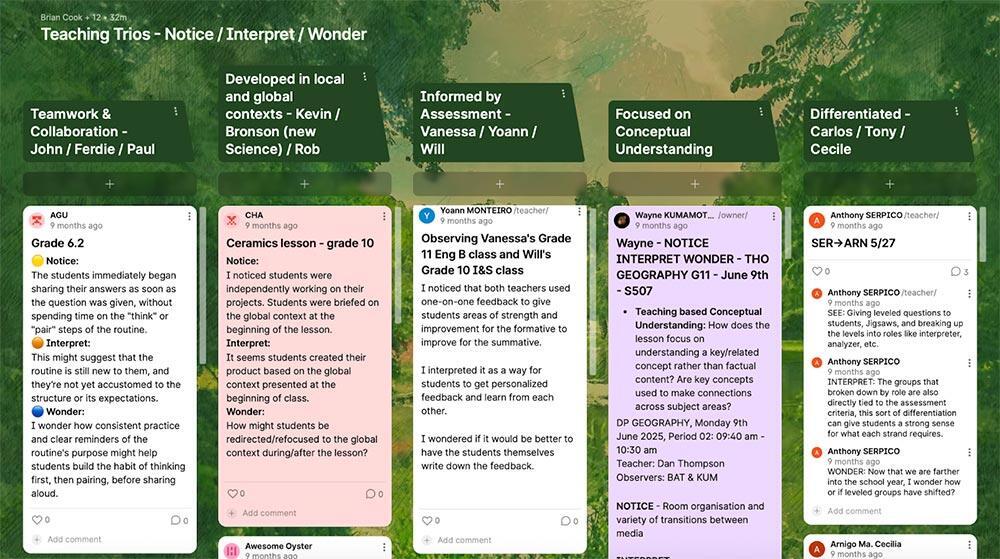
Notice / Interpret / Wonder Protocol This protocol is used to structure feedback shared via Padlet:
- Notice: Objective reporting of observable facts (e.g., "I noticed students leading the discussion").
- Interpret: Drawing evidence-based implications (e.g., "It seems they were confident using the protocol").
- Wonder: Posing questions to spark future inquiry (e.g., "I wonder how you helped students prepare for this autonomy").
Thematic Analysis and Sharing
- Four Corners Session: Teachers engage in thematic analysis of successes and challenges across four pillars: Student Agency, Real-World Relevance, Feedback/Feedforward, and Structured Flexibility.
- Inter-Trio Gallery Walk: Successes and challenges are shared across different trios to identify school-wide themes and common pedagogical levers.
- Observation Log as a Technical Tool: The Observation Log is used to record time-stamped, verbatim evidence and tallies. This log serves as a vital tool for triangulation during the debrief, allowing the trio to compare the observer's data with the teacher's experience to answer the Research Question.
6. Reflection and Professional Growth Framework
Reflection is standardized through specific routines designed to measure individual growth and conceptual shifts.
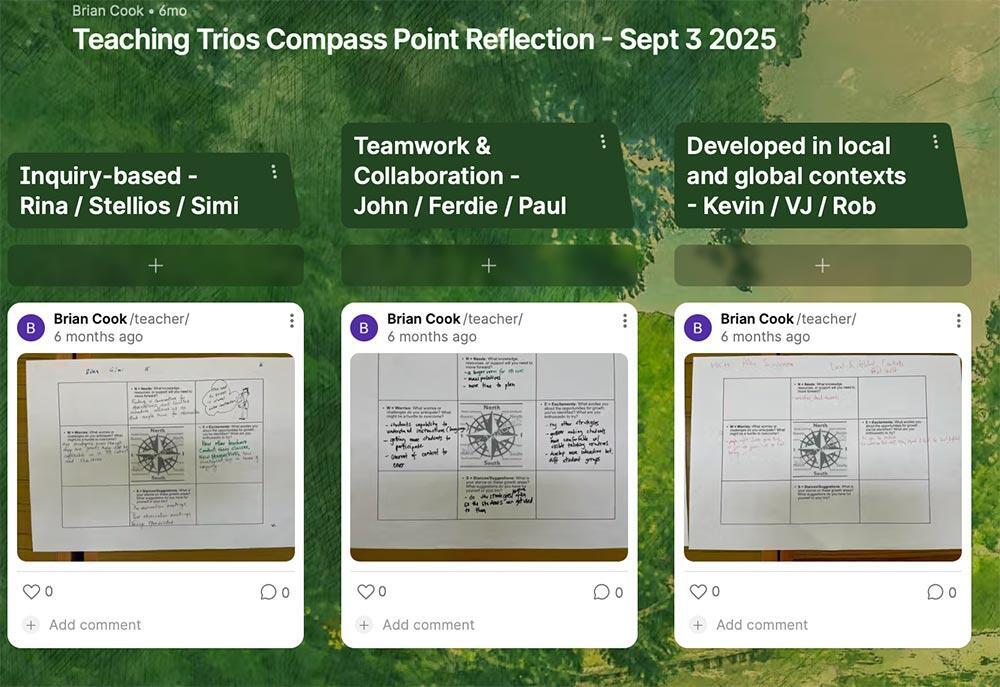
The Compass Points Routine Teachers apply this routine to individual goal-setting and trio sharing using these specific questions:
- Excitements (East): What excites you about the opportunities for growth you've identified? What are you enthusiastic to try?
- Worries (West): What worries or challenges do you anticipate? What might be a hurdle to overcome?
- Needs (North): What knowledge, resources, or support will you need to move forward?
- Stances/Suggestions (South): What is your stance on these growth areas? What suggestions do you have for yourself or your trio?
The Conceptual Shift The "I used to wonder... Now I think..." routine is used in the Round 2 Workbook to document the "conceptual leap" from general initial wonderings in April to the specific strategies applied in the second round of observations.
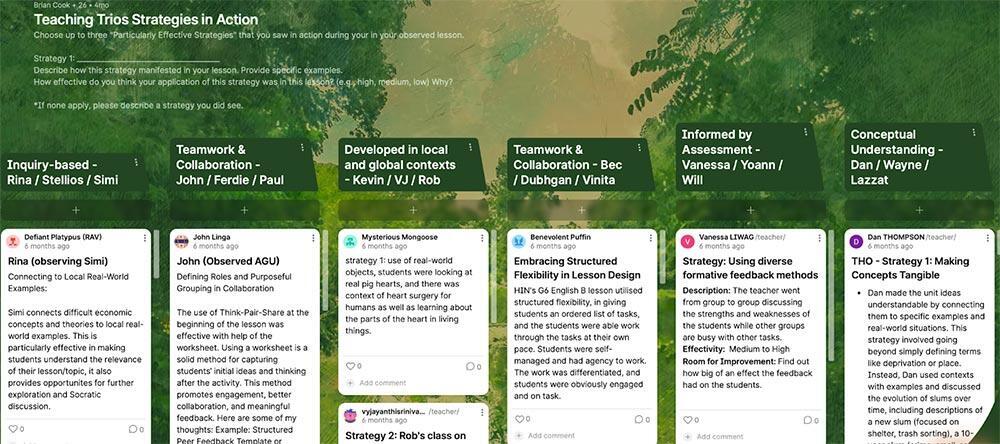
Particularly Effective Strategies The following high-leverage levers have been identified across trios:
- Explicitly Teaching Questioning Skills
- Defining Roles and Purposeful Grouping in Collaboration
- Connecting to Local Real-World Examples
- Using Diverse Formative Feedback Methods
- Differentiating by Choice and Peer Learning
- Making Concepts Explicit and Applied
- Promoting Student Agency and Active Participation in Learning
- Embracing Structured Flexibility in Lesson Design
7. Conclusion and Future Considerations
The Teacher Trios project provides a robust framework for long-term improvement in student outcomes.
Anticipated Impact for Students:
- Increased consistency in the application of ATTs skills across subjects.
- Enhanced engagement through inquiry-based and concept-driven instruction.
- Stronger communication and cross-department collaboration
The project concludes with a final blog post requiring photographic evidence of these successful strategies in action. These evidence-based insights are measured against the Tamagawa Teaching Standards and are aligned with the development of the IB Learner Profile, ensuring a sustainable impact on the school's pedagogical culture.
Citation
Cook, Brian. "Action Research Project Report: Strengthening Teaching Practices through the Teacher Trios Framework." Tamagawa K-16 Research Centre, 1/4/2026, [URL]. Assisted by Gemini, Google, [17/3/2026], https://gemini.google.com/.